Physical Address
304 North Cardinal St.
Dorchester Center, MA 02124
 Skip to content
Physical Address
304 North Cardinal St.
Dorchester Center, MA 02124


Roses are loved by most flower gardeners but they can be a challenge to grow and keep healthy because they are sensitive plants. Therefore, they are difficult to cultivate and take care of. Nonetheless, proper pruning can easily lead to beautiful and healthy roses of different kinds. Not only does pruning enhance growth, but it also prevents disease occurrence. In this guide, you will learn how to prune roses and get those beautiful blooms you direly desire.
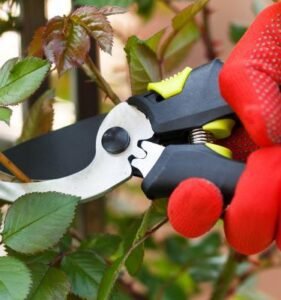
Some of the essential tools required for pruning include:
Pruning of most roses happens before early spring starts as this is the time new growth is experienced. During this time one can determine the condition of the plant. For some rose types especially those that bloom on old wood (such as climbing roses) they need to be pruned after flowering has occurred. New buds’ emergence and the lack of leaves a signs you need to prune your roses.
Follow these guidelines to prune your roses to help them thrive:
Before pruning can start, you are required to assess the general structure and health of the rose plant. Start by removing all of the leaves in your rose bush, which allows you to see the structure of the rose bush and stems.
You should now focus on spotting and removing any dead wood by making a small cut into the cane. If you notice the inside is brown, it is dead, while green will indicate that it is healthy. Remove all dead wood down to the plant’s base.
The center of the plant needs to be opened once all dead wood has been removed. Look for branches that are crossing each other and can cause injury through rubbing, which may lead to infection or pests. Strive for a vase-like shape with branches that grow upward, as this promotes healthy growth while decreasing fungal disease risks.
Continue cutting, taking any weak growth with them. Remove any stems that are thinner than a pencil. These weak canes can reduce a plant’s vitality and prevent healthy blooms. By focusing on thicker canes, you can help the plant redirect its energy toward developing strong growth.
At this point, cut off the remaining canes. Cuts should be made about 1/4 to 1/2 inch above an outer-facing bud eye or node where the leaf attaches to the petiole. This causes new stems to shoot outwards instead of inwards, thus helping maintain an open structure. Additionally, ensure that cuts are made at a 45-degree angle pointing away from the bud so as not to allow any moisture retention that may cause rotting crops.
Following pruning, it is essential to keep pests like rose borers from freshly cut canes. You should cover the cuts with a pruning sealer. Sealing wounds helps avoid diseases and maintains a healthy plant while it starts to recover from pruning.
Once you are done with pruning, ensure that the area is cleaned thoroughly. All fallen leaves or branch pieces should be removed, as they can harbor diseases and pests. Between plants, wipe your pruning tools with isopropyl alcohol to prevent the spreading of pollutants you will have wiped off.
Finally, roses are ‘big eaters’ and require proper nutrition for maximum growth. Apply a slow-release fertilizer to the roses after pruning. Such a fertilizer will provide the essential nutrients needed for vigorous growth and bright blooms during the growing season.
Pruning methods differ according to the kind of rose being dealt with.
Generally, prune the rose bushes to the height that one wishes, keeping the shape uniform. Hybrid teas that are cut at lower heights yield bigger flowers and longer stems suitable for cutting. On the other hand, taller pruning produces many small flowers.
Climbing roses have two types of canes: the main ones at the base and the lateral ones, which bear flowers. While all forms of pruning apply here, it matters less about shaping them out. However, it is recommended that lateral canes be pruned at any time to support blooming.
Knock-out roses are pruned in the second or third season, generally late winter or early spring. Since they bloom on new growth, one should first remove old, dead, and broken canes by cutting them back to ground level. You should prune about one-third of their height. Deadheading will encourage new flowers.
In warmer climates, leave rose hips on through fall and winter to signal dormancy. In colder areas, roses naturally enter dormancy, but in warmer regions, allowing hips to form can help trigger this process.
All in all, pruning roses may seem daunting, but with the right tools and techniques, it becomes a rewarding practice that promotes healthy growth and stunning blooms. By following this step-by-step guide, you can confidently maintain your rose bushes, prevent diseases, and ensure vibrant flowering. Remember, proper timing, careful cuts, and consistent care make all the difference. Embrace the process and enjoy the beauty of well-pruned roses in your garden
 Optimized by Seraphinite Accelerator